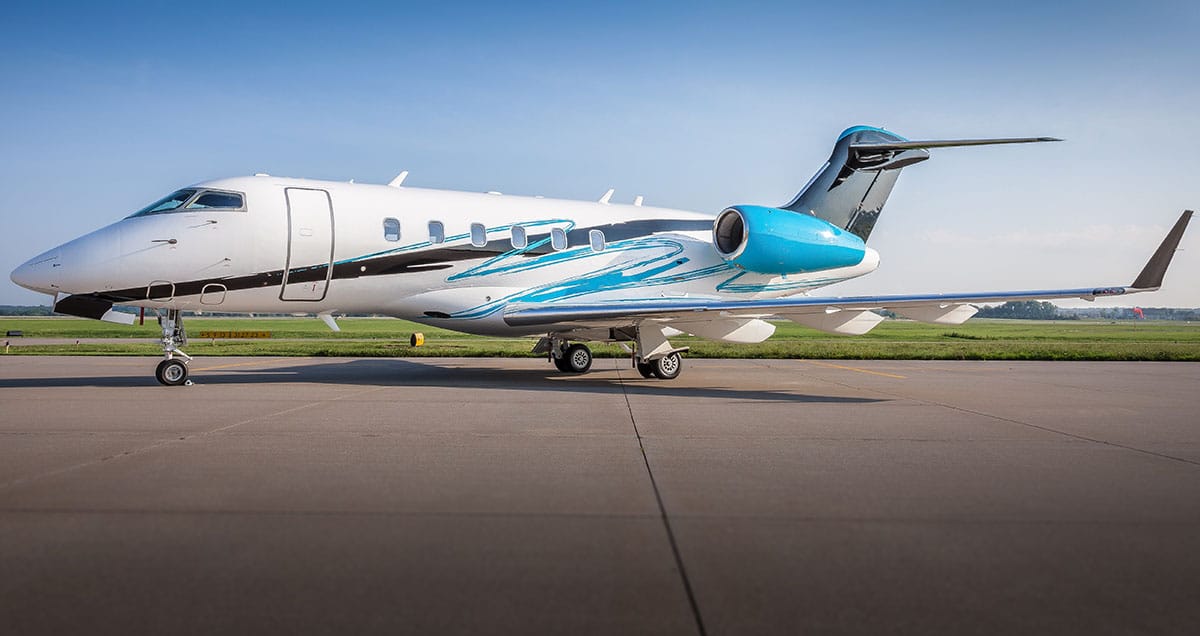
Bombardier Challenger Family: The Most Demanded Private Jets for Medium and Large Range
The Bombardier Challenger family is one of the most successful private jet families in aviation history. This family extends from the Challenger 300 (Super Midsize category) to the Challenger 605/650 (Large Jet category). These aircraft are known for their extremely spacious cabins, intercontinental range, and high level of reliability. They are used by Fortune 500 companies, charter operators, and even some governments around the world.
Challenger 300 and 350 – Super Midsize Category
History and Evolution
The Challenger 300 first appeared in 2004, offering a stand-up cabin with sufficient range to cross the Atlantic Ocean, making it a game-changer in the super-midsize aircraft category. In 2014, Bombardier launched the upgraded Challenger 350, which featured a more modern cabin, larger windows, and an advanced entertainment and work system. Production continues under the name Challenger 3500, but the 300 and 350 models remain in high demand in the pre-owned market.
The Cabin: Real Space for Passengers
The Challenger 300/350 features a spacious cabin that allows comfortable movement:
- Height: 6 feet (1.83 meters) – most passengers can stand fully and walk around without needing to bend, making a significant difference on flights longer than 5 hours.
- Width: 7 feet 2 inches (2.18 meters) – provides comfortable space between facing seats and allows easy passage.
- Length: 22 feet (6.71 meters) – divided into three areas: forward salon, main seating area, and a rear area containing the bathroom and galley.
- Passenger capacity: 8 to 9 passengers in the standard configuration (typically a double club with a rear divan), with a maximum of 10 seats.
Challenger 350 Amenities
The 350 model (from 2014 onward) offers an advanced experience including:
- A full galley equipped with an oven, microwave, and large refrigerator, enabling hot meal preparation in the air.
- A shower-equipped bathroom in most models, a rare feature in this category.
- An integrated entertainment and work system with high-speed Wi-Fi.
- Convertible seats into beds in some interior configurations.
- Larger windows compared to the Challenger 300, allowing more natural light.
Technical Performance (Challenger 350)
- Range: 3,600 nautical miles (6,667 km) – practically sufficient to connect cities like New York to London (approximately 3,450 miles), Los Angeles to Honolulu (2,500 miles), or London to Dubai (3,400 miles) non-stop.
- Maximum speed: 460 knots (Mach 0.82) – approximately 850 km/h.
- Service ceiling: 45,000 feet – allows flying above most weather systems and commercial traffic.
- Engines: two Honeywell HTF7350, each producing 7,323 pounds of thrust.
- Takeoff distance: 4,670 feet (1,424 meters) – very good performance for its category, allowing operations from airports like Teterboro and Nice.
- Cabin pressurization: maintains an altitude equivalent to 5,200 feet when flying at 43,000 feet, reducing passenger fatigue.
Avionics
The Challenger 350 features the advanced Collins Pro Line Fusion system, which includes:
- 4 customizable wide screens.
- Synthetic Vision that displays terrain and runway in 3D even in foggy conditions.
- Multi-scan weather radar to avoid storms.
- TCAS II collision avoidance system.
- Two-pilot operation (not certified for single-pilot operation, unlike some competitors such as Citation Sovereign).
Challenger 600 Series (604 / 605 / 650) – Large Jet Category
History
The series began with the Challenger 600 in 1980, then evolved into the 601, then the 604 (1995), 605 (2006), and finally the 650 (2015). These aircraft are larger than the 300 series, designed to accommodate more passengers and perform longer flights, and are classified as Large Jets.
Challenger 650 Cabin
The Challenger 650 cabin offers a very spacious experience suitable for long flights and large delegations:
- Height: 6 feet 1 inch (1.85 meters).
- Width: 8 feet (2.44 meters) – allows comfortable placement of a side-facing sofa and meeting table.
- Length: 28 feet 8 inches (8.74 meters) – divided into four functional areas:
- Forward meeting salon (seating 4-5).
- Central entertainment and dining area with a large table.
- Full galley with oven, kettle, and refrigerator.
- Private rear sleeping area with a bed for two (or convertible sofa) and a full bathroom with an actual shower.
- Passenger capacity: 12 to 14 passengers in standard configuration, with a maximum of 19 passengers in dense configuration.
Challenger 650 Performance
- Range: 4,000 nautical miles (7,400 km).
- Practical applications:
- New York to Geneva (approximately 3,800 miles) – non-stop.
- Los Angeles to London (5,400 miles) – requires one stop, but easily covers Los Angeles to Honolulu (2,500 miles).
- London to Dubai (3,400 miles) – non-stop.
- New York to Moscow (4,200 miles) – may not reach in headwind conditions, where aircraft like G550 or Global are preferred.
- Speed: 0.80 – 0.82 Mach (approximately 470 knots).
- Service ceiling: 41,000 feet.
- Engines: two General Electric CF34-3B, each producing 9,220 pounds of thrust – extremely reliable but less fuel-efficient compared to newer competitors.
- Takeoff distance: 5,700 feet (1,737 meters) – longer than the Challenger 350, requiring longer primary runways.
Avionics
- Challenger 604/605: Collins Pro Line 4 system (older generation, upgradeable).
- Challenger 650: Collins Pro Line Fusion system (similar to the 350, with modern screens and synthetic vision).
Technical Comparison: Challenger 350 vs Challenger 650
| Feature | Challenger 350 (Super Midsize) | Challenger 650 (Large Jet) |
|---|---|---|
| Range (nautical miles) | 3,600 | 4,000 |
| Standard passenger capacity | 8 – 10 | 12 – 14 |
| Cabin height | 6 feet | 6 feet 1 inch |
| Cabin length | 22 feet | 28 feet 8 inches |
| Shower-equipped bathroom | Optional (available on most 350 models) | Yes |
| Separate sleeping area | No (some seats can be converted) | Yes |
| Service ceiling | 45,000 feet | 41,000 feet |
| Takeoff distance | 4,670 feet | 5,700 feet |
Technical Summary: The Challenger 350 offers an ideal balance of transatlantic range, interior space suitable for 8-9 passengers, and operational efficiency. The Challenger 650 is the ideal choice for those who need real space for 12 or more passengers with a separate sleeping area and full shower-equipped bathroom, accepting longer takeoff distance and higher fuel consumption.
Comparison with Competitors (Challenger 350 vs Gulfstream G450 vs Falcon 2000LX)
| Feature | Challenger 350 | Gulfstream G450 | Falcon 2000LX |
|---|---|---|---|
| Category | Super Midsize | Large Jet | Super Midsize |
| Range (nautical miles) | 3,600 | 4,350 | 4,000 |
| Cabin height | 6 feet | 6 feet 2 inches | 74 inches |
| Passenger capacity | 8-10 | 12-14 | 8-10 |
| Shower-equipped bathroom | Optional | Optional | Yes |
When to Choose the Challenger 350?
- When you need sufficient transatlantic range (such as New York-London) regularly, without paying the higher costs of the Large Jet category.
- When you want a spacious stand-up cabin for groups of 8 to 9 people, with modern amenities such as a full galley and shower (in the 350 model).
- When you are looking for a relatively modern aircraft (2014 onward) with advanced avionics (Collins Pro Line Fusion).
- If you are a charter operator – the Challenger 350 is one of the most sought-after aircraft in the market, ensuring easy charter and utilization.
The Challenger 350 is not for you if:
- You regularly need range exceeding 4,000 nautical miles (such as the US to Japan or Australia).
- You need a separate sleeping area with a full shower for 4 or more people (in which case the Challenger 650 or G550 is preferred).
- You need an aircraft with lower purchase costs (in which case you could consider the older Challenger 300 or Citation Sovereign).
When to Choose the Challenger 650?
- When you need real space for 12 to 14 passengers with a separate sleeping area and a shower-equipped bathroom.
- When you operate in government or special mission applications – the Israeli and US Air Forces have relied on this platform.
The Challenger 650 is not for you if:
- Fuel efficiency is a top priority (it consumes 20-25% more fuel than the Challenger 350).
- You operate from short runways (it requires 5,700 feet, while the Challenger 350 requires only 4,670 feet).
- You are looking for the latest avionics (the 650’s system is good, but newer aircraft like the G500 offer more advanced technologies).
Final Summary
The Challenger 350 represents the ideal choice in the Super Midsize category for the practical operator. It combines sufficient range for transatlantic crossings, a very spacious cabin for 8-9 passengers, reasonable operating costs, and excellent market value. For this reason, it is the preferred choice for charter operators and regional Fortune 500 teams.
The Challenger 650 represents an accessible entry into the world of Large Jets at a competitive price in the pre-owned market. It offers luxurious space for larger groups, but shows some limitations in fuel efficiency and takeoff distance compared to newer competitors such as the Gulfstream G500 or Global 6000. However, its attractive price (in the pre-owned market) continues to entice many operators.
Final advice: If you are looking for an aircraft for regular intercontinental flights (with a range of less than 3,600 nautical miles) for a group of 8 people, the Challenger 350 is one of the smartest choices in the pre-owned private jet market today. And if you need more space for 12-14 passengers with a sleeping area and shower, the Challenger 650 is worth serious consideration, especially if you find an upgraded version with a modern avionics system.