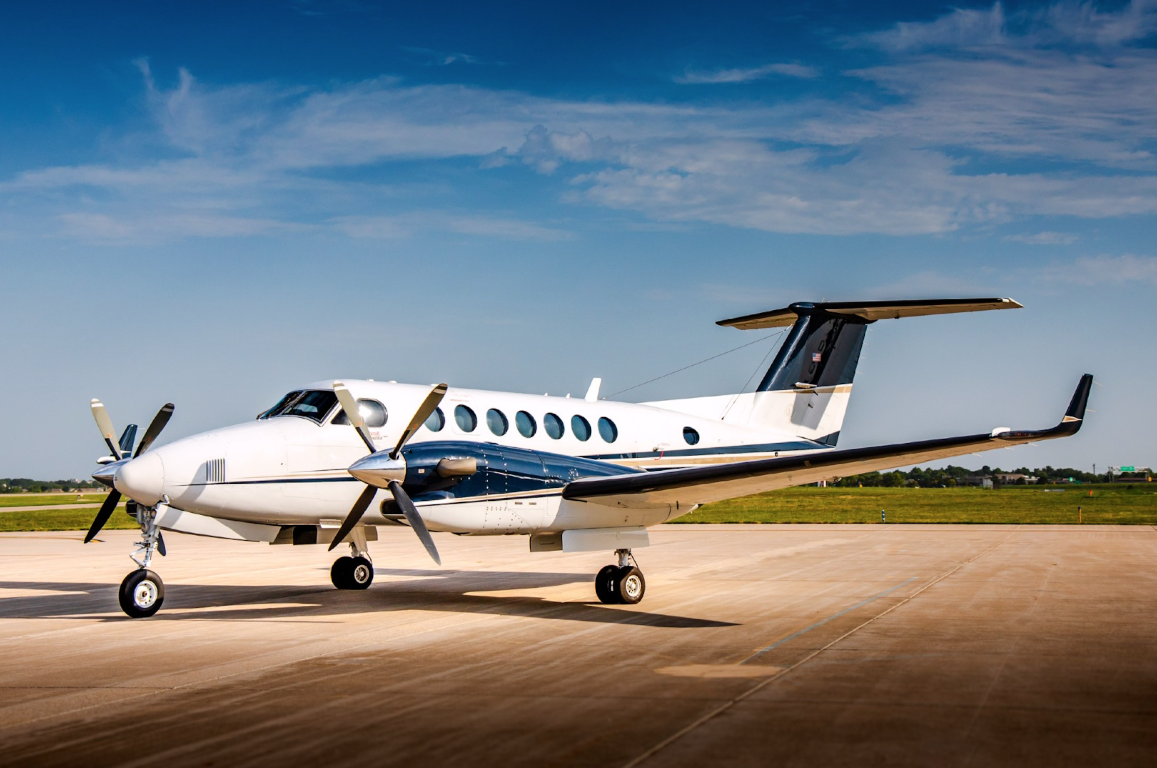
The Beechcraft King Air 350 and its enhanced variant, the King Air 350i, represent the pinnacle of turboprop aircraft design. For over three decades, these aircraft have served business executives, leisure travelers, and special mission operators with distinction. They occupy a unique position in private aviation, offering the comfort of a cabin class aircraft with the operating efficiency of a turboprop.
This guide provides a thorough examination of these remarkable aircraft, covering their design, performance, cabin amenities, and operational capabilities.
Cabin Design and Passenger Comfort
Interior Configuration
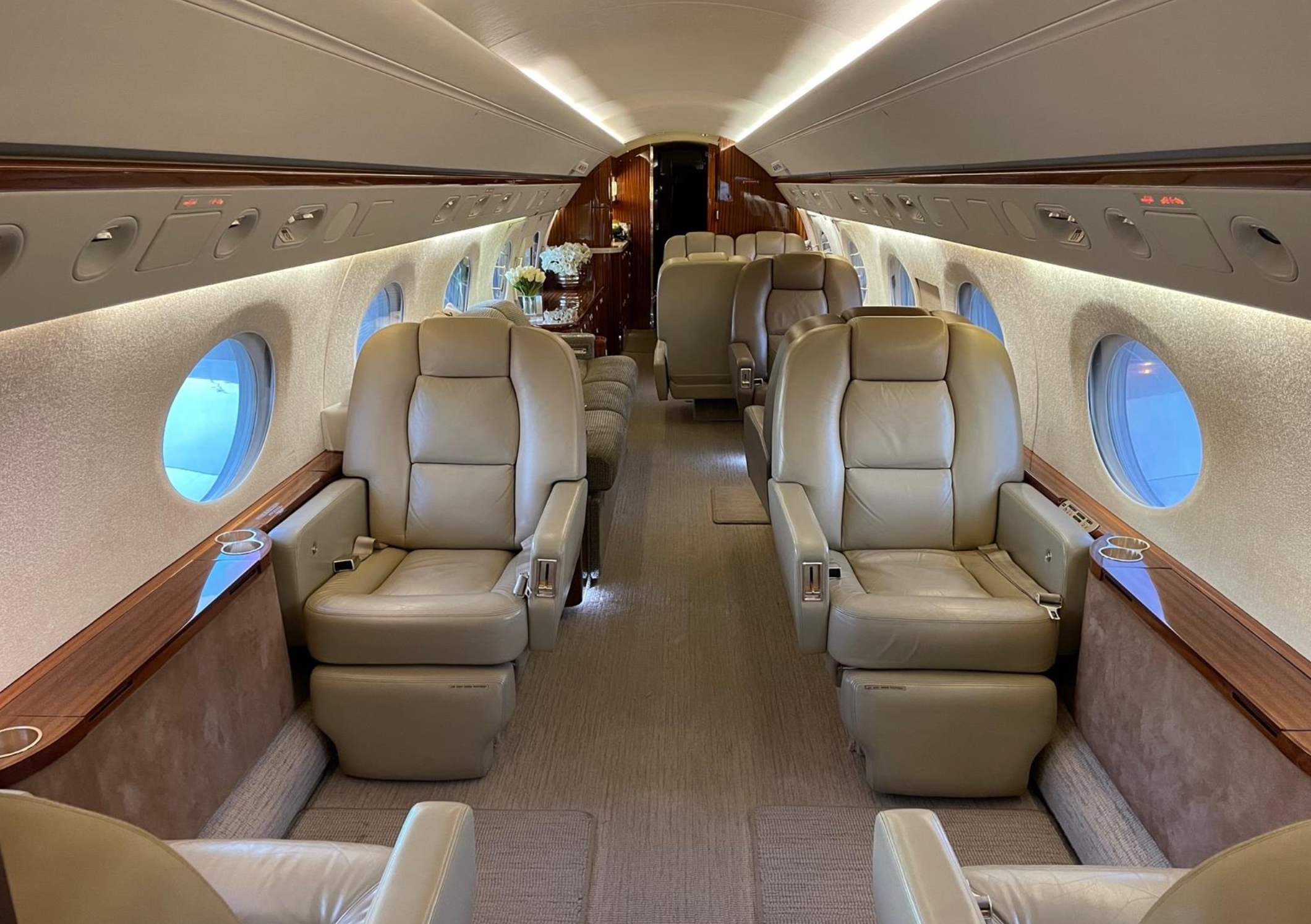
The King Air 350 cabin measures 19 feet 2 inches in length, 4 feet 10 inches in height, and 4 feet 6 inches in width. This creates a total volume of 344 cubic feet, offering passengers room to move comfortably throughout the flight.
The standard seating arrangement places eight passengers in two club sections. Each seat features generous legroom, proper recline capability, and individual lighting and air vents. Fold-out tables provide work surfaces for business travelers or dining areas for leisure passengers.
King Air 350i Enhancements
The 350i variant introduced significant cabin improvements:
- FlexCabin system allowing easier reconfiguration
- Advanced noise cancellation technology reducing cabin noise
- Heated seats for enhanced passenger comfort
- Pull-out tables for work and dining
- Built-in refreshment center with beverage storage
- Power outlets and USB ports at each seat
- Wi-Fi connectivity throughout the cabin
- Remote controls in armrests for lighting and entertainment
Large circular windows with effective polarizer shades provide excellent natural light and views while allowing passengers to control brightness as desired.
Baggage Capacity
The aircraft offers generous baggage capacity of 55 to 71 cubic feet, accommodating up to 550 pounds. This space easily holds five soft suitcases plus golf clubs, ski equipment, or business samples. Wing lockers provide additional storage for smaller items.
Performance Specifications
Powerplant
Both the King Air 350 and 350i are powered by two Pratt & Whitney Canada PT6A-60A reverse-flow, free turbine engines. Each engine produces 1,050 shaft horsepower at takeoff. These engines are renowned throughout the aviation industry for their reliability, durability, and efficient operation.
Range and Speed
The aircraft cruises at approximately 312 knots (360 miles per hour). Typical range is 1,800 nautical miles, with the extended range 350ER version capable of reaching 2,311 nautical miles. This enables non-stop flights such as:
- London to Madrid
- New York to Miami
- Los Angeles to Denver
- Toronto to Montreal
Altitude and Pressurization
Service ceiling is 35,000 feet, allowing the aircraft to operate above most weather systems and commercial traffic. The pressurization system maintains a sea-level cabin altitude up to 15,293 feet, reducing passenger fatigue on longer flights.
Runway Performance
The King Air 350 requires only 3,300 feet of runway for takeoff at sea level, with landing distance of approximately 2,692 feet. This short-field capability provides access to thousands of smaller airports unavailable to jet aircraft, including popular destinations such as Aspen, Jackson Hole, and Teterboro.
Noise Control
Aircraft manufactured after 1998 feature the Ultra Electronics UltraQuiet noise control system, maintaining cabin noise below 80 decibels. This enables normal conversation and reduces passenger fatigue.
Avionics and Technology
King Air 350 Avionics
Original King Air 350 aircraft featured:
- Rockwell Collins ProLine II avionics suite
- Universal UNS-1D/UNS-1K navigation system
- ALT-80A altimeter
- Dual airspeed indicators and flight director
- Optional Rockwell Collins EFIS-8B electronic flight information system
Later production models incorporated Rockwell Collins ProLine 21 avionics as standard equipment.
King Air 350i Avionics
The 350i features the advanced Collins Aerospace ProLine Fusion avionics suite, which includes:
- Synthetic vision technology displaying terrain and obstacles regardless of visibility
- Enhanced situational awareness through integrated flight displays
- Engine Indicating and Crew Alerting System for real-time monitoring
- Traffic Alert and Collision Avoidance System for enhanced safety
- Multi-scan weather radar for storm detection and avoidance
- NextGen navigation capabilities for precision approaches
Single-Pilot Operation
The aircraft is certified for single-pilot operation, offering scheduling flexibility and reduced crew costs for owner-operators. Most charter operations utilize two pilots for enhanced safety and workload management.
Operational Versatility
Passenger Transport
The King Air 350 serves as an excellent platform for corporate and leisure travel. The comfortable cabin, efficient performance, and short-field capability make it ideal for regional travel and access to remote destinations.
Special Mission Applications
Beyond passenger transport, the aircraft performs numerous special mission roles:
- Air ambulance and medical evacuation with specialized interior configurations
- Aerial survey and mapping with sensor installations
- Search and rescue operations
- Coastal and border patrol for government agencies
- Military training (operated by multiple air forces)
- Cargo transport with large door configuration
The King Air 350ER extended range version is particularly popular for special mission applications, featuring increased fuel capacity, strengthened landing gear, and optional belly pod for additional equipment.
Variants
King Air 350
The original variant, produced from 1990 to 2009. Features proven performance, reliable systems, and wide availability in the pre-owned market.
King Air 350i
Introduced in 2010 with enhanced cabin amenities, improved noise control, and upgraded avionics. The 350i offers a more modern passenger experience while maintaining the same performance characteristics.
King Air 350C
Features a large cargo door for freight, air ambulance, and special mission applications. Maintains the same performance as standard models with enhanced loading capabilities.
King Air 350ER
Extended range version with increased fuel capacity, strengthened landing gear, and maximum takeoff weight of 16,500 pounds. Range extends to 2,311 nautical miles. Popular for special mission and government operations.
Market Position
Charter Operations
The King Air 350 and 350i are widely available through charter providers worldwide. Their combination of passenger comfort, operational flexibility, and cost-effectiveness makes them popular choices for regional travel.
Ownership Considerations
Pre-owned aircraft values typically range from $2.5 million to $3.8 million for standard 350 models, while 350i variants command $4.1 million to $6.5 million depending on age, condition, and equipment.
Operational Economics
The aircraft offers favorable operating economics compared to light jets, with lower fuel consumption and maintenance costs while providing similar passenger capacity and comfort for regional missions.
Manufacturer Background
The King Air line traces its heritage to Beech Aircraft Corporation, founded by Walter Beech in 1932. The company merged with Raytheon in 1980, becoming Raytheon Aircraft Company. Hawker Beechcraft acquired the business in 2007, and following restructuring, the company emerged as Beechcraft Corporation in 2013.
Today, Beechcraft is part of Textron Aviation, which also includes Cessna and Hawker brands. Textron Aviation continues to support the extensive King Air fleet with parts, service, and engineering support.
Conclusion
The Beechcraft King Air 350 and 350i represent a mature and refined aircraft platform that has served the aviation community faithfully for over thirty years. They offer a compelling combination of passenger comfort, operational flexibility, and cost-effectiveness that remains relevant in contemporary private aviation.
For travelers requiring regional access with the ability to utilize smaller airports, for operators seeking reliable and efficient aircraft, and for passengers who appreciate thoughtful cabin design and comfortable travel, the King Air 350 series delivers exceptional value.
When considering private air travel for groups of up to eight passengers on regional routes, the Beechcraft King Air 350 and 350i deserve serious consideration.
You might also like
Cessna Citation Sovereign: The Private Jet That Does Everything Well
Gulfstream G400 vs G450 vs G550: Which Business Jet Is Right for You?