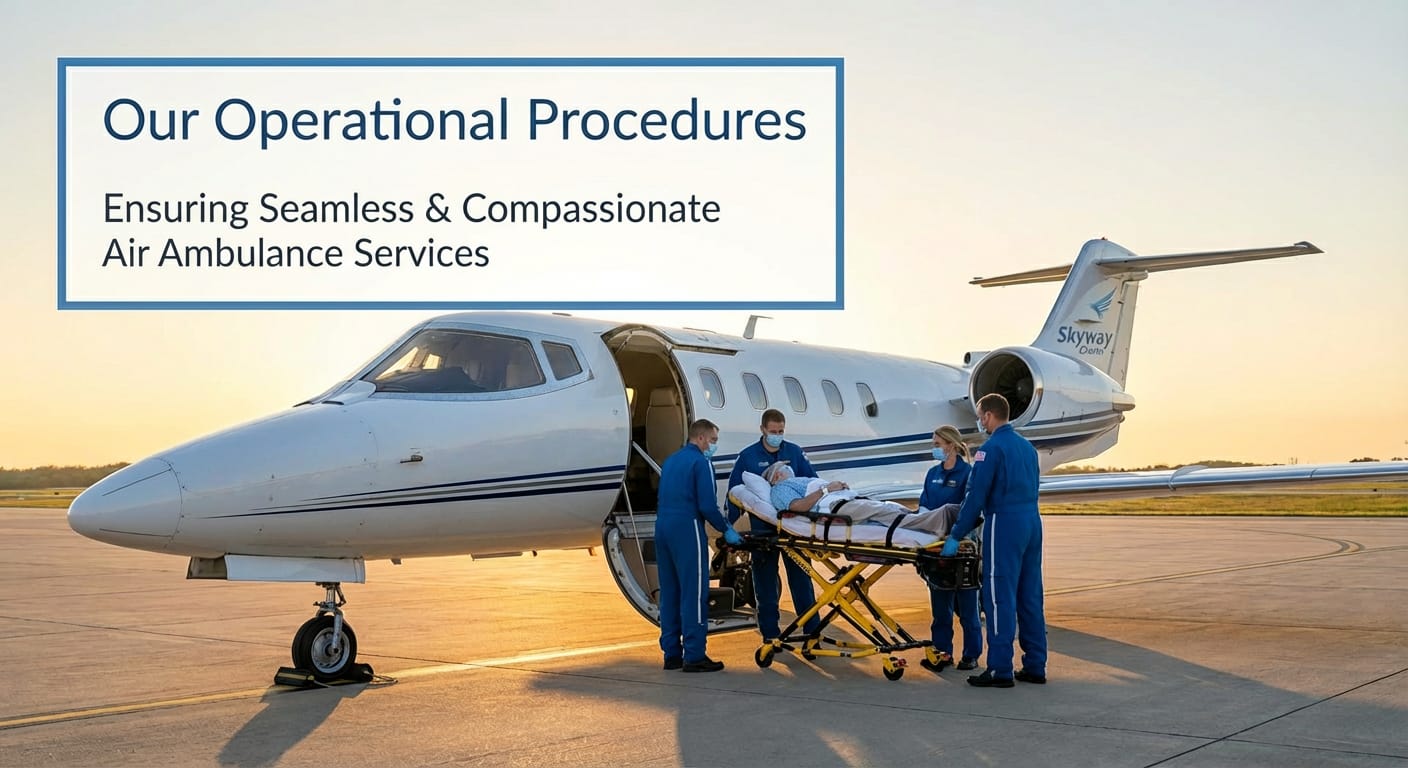
The Flying Hospital: When Time Is Life
Our Operational Procedures Up to Contract Signing
| Phase | Procedure |
|---|---|
| 1. Request Intake & Assessment | Receiving the service request supported by a recent and comprehensive medical report to accurately assess the situation. |
| 2. Medical & Technical Analysis | Our team analyzes the medical report to determine the precise flight requirements (aircraft type, equipment, medical crew). |
| 3. Sending RFQ to Operators | Sending quotation requests directly to our certified network of available and qualified aircraft operators. |
| 4. Transparent Presentation of Options | We receive the quotations and present them directly to you without modification, objectively explaining the details of each offer. |
| 5. Consultative Support for Selection | We provide free consultation to help you compare the offers and choose the most suitable one for your needs and budget. |
| 6. Finalizing the Direct Contract | We coordinate the final arrangements for the contract to be signed directly between you and the operator, with the option for one of our consultants to accompany you during the signing as complimentary support. |
The Critical Missions of a Flying Hospital
The deployment of an air ambulance is a strategic medical decision, activated for scenarios where every minute counts.
The Emergency Scene Response:
Often utilizing helicopters for their agility, air ambulances can descend directly to the site of a major accident—a highway collision, a hiking injury in a national park, or an industrial incident—to provide immediate, advanced life support and rapid transport to a trauma center.
The Inter-Hospital Transfer:
This is a cornerstone of their service. When a patient at a community hospital requires a level of care only available at a specialized center—be it for neurosurgery, comprehensive burn treatment, or cardiac intervention—an air ambulance facilitates a safe, swift transfer. This ensures the patient reaches the definitive care they need without delay. This is patient transfer at its most critical.
The International Repatriation:
For individuals who fall seriously ill or are injured while overseas, the logistical and medical challenges can be overwhelming. An air ambulance provides a secure, medically supervised pathway home, coordinating complex international logistics to deliver patients directly to their home-country medical teams. This is international repatriation in action.
The Race for Transplant:
In the world of organ donation, time is the most precious commodity. Air ambulances play a vital role in transplant medicine, enabling the rapid, temperature-controlled transport of donor organs and surgical teams across vast distances, turning logistical possibility into life-saving reality. This is organ transport at its most urgent.
An ICU Above the Clouds: Technology and Expertise
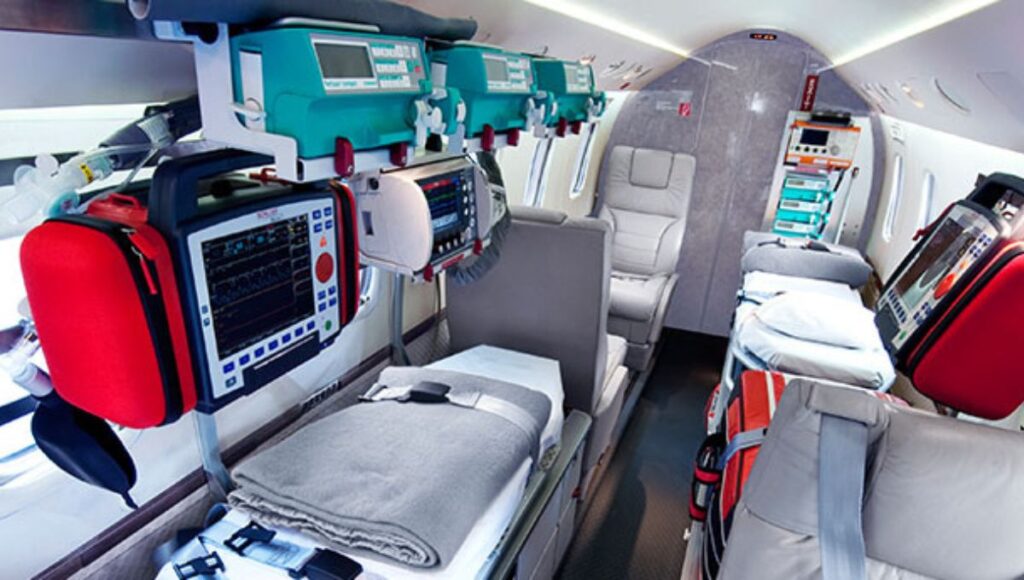
Stepping inside an air ambulance reveals an environment engineered for stability and intervention. It is a self-contained clinical pod, equipped with technology rivaling that of a ground-based ICU.
Advanced Medical Capabilities:
The cabin is outfitted with ventilators for assisted breathing, cardiac monitors and defibrillators, infusion pumps for precise medication delivery, and a full pharmacy of emergency drugs. This allows medical teams to manage everything from cardiac arrest to respiratory failure en route.
The Human Element: Specialized Medical Teams:
The technology is guided by expert hands. Each mission is staffed by a highly trained crew, typically including a critical care flight nurse and a flight paramedic, with additional specialists like neonatal or pediatric intensivists available for specific cases. These professionals are uniquely trained to operate in the confined, dynamic, and challenging airborne environment. This is the essence of aeromedical services.
A Symphony of Coordination: From Call to Handover
The visible flight is the culmination of an intricate, behind-the-scenes operation.
Activation and Triage:
The process begins with a call from a doctor, hospital, or family. A medical coordinator assesses the patient’s condition, determining the medical necessity and logistical feasibility of air transport. This is the start of every medical evacuation.
Strategic Planning:
A dedicated operations team springs into action. They select the optimal aircraft (helicopter for short-range agility or fixed-wing jet for long-distance speed), secure overflight and landing permissions—especially critical for international borders—and coordinate every detail with both the referring and receiving medical facilities.
Seamless Execution:
A ground ambulance delivers the patient to the waiting aircraft, where the in-flight medical team assumes care. This care continues uninterrupted throughout the journey. Upon landing, another coordinated handoff delivers the patient directly into the care of the waiting specialist team at the destination hospital.
Why This Lifeline Is Indispensable
The value of air ambulance services is measured in saved lives and improved recoveries. For time-sensitive conditions like a major heart attack (STEMI), acute stroke, or severe trauma, studies consistently show that reducing the time to definitive treatment dramatically lowers mortality and reduces long-term disability.
Beyond the statistics, these services embody a principle of equity in healthcare. They ensure that geography does not dictate destiny, guaranteeing that a patient in a rural community or a remote island has the same fighting chance as someone in a major city. In short, the air ambulance is more than a vehicle; it is a vital lifeline, a testament to human innovation in the relentless pursuit of preserving life against the odds. This is emergency flight at its finest.